Skip to content
How Strategic SEO Helped My Salah Mat Strengthen Organic Visibility and Ecommerce Performance
Client: My Salah Mat
Industry: Islamic Ecommerce
Website: My Salah Mat
Platform: Ecommerce
SEO Duration: 6 Months
Reporting Period: 28-day comparison periods
Primary Focus: Ecommerce SEO, Technical SEO, On-Page SEO, Content Strategy & Internal Linking
The Challenge
My Salah Mat is an ecommerce brand offering Islamic products designed to help children and families learn, engage, and develop meaningful Islamic habits.
Like many ecommerce businesses, the challenge was not simply having a well-designed online store. The bigger challenge was building consistent organic visibility and turning search visibility into meaningful ecommerce performance.
The SEO campaign focused on improving the website’s overall search presence while strengthening important product and commercial pages.
The main objectives were to:
- Increase organic visibility
- Improve keyword rankings
- Optimize product pages
- Strengthen ecommerce website structure
- Improve internal linking
- Target relevant search intent
- Build topical relevance
- Increase qualified organic traffic
- Support long-term ecommerce growth
The Starting Point
At the beginning of the SEO campaign, the website was generating approximately:
$1K Revenue
during the selected 28-day comparison period.
The goal was to improve the website’s organic search performance and create a stronger foundation for sustainable ecommerce growth.
Instead of relying on a single SEO tactic, the campaign used a combination of technical, on-page, content, and ecommerce optimization.
Six Months of SEO Growth
After approximately six months of SEO work, the later 28-day reporting period showed:
$8K Total Revenue
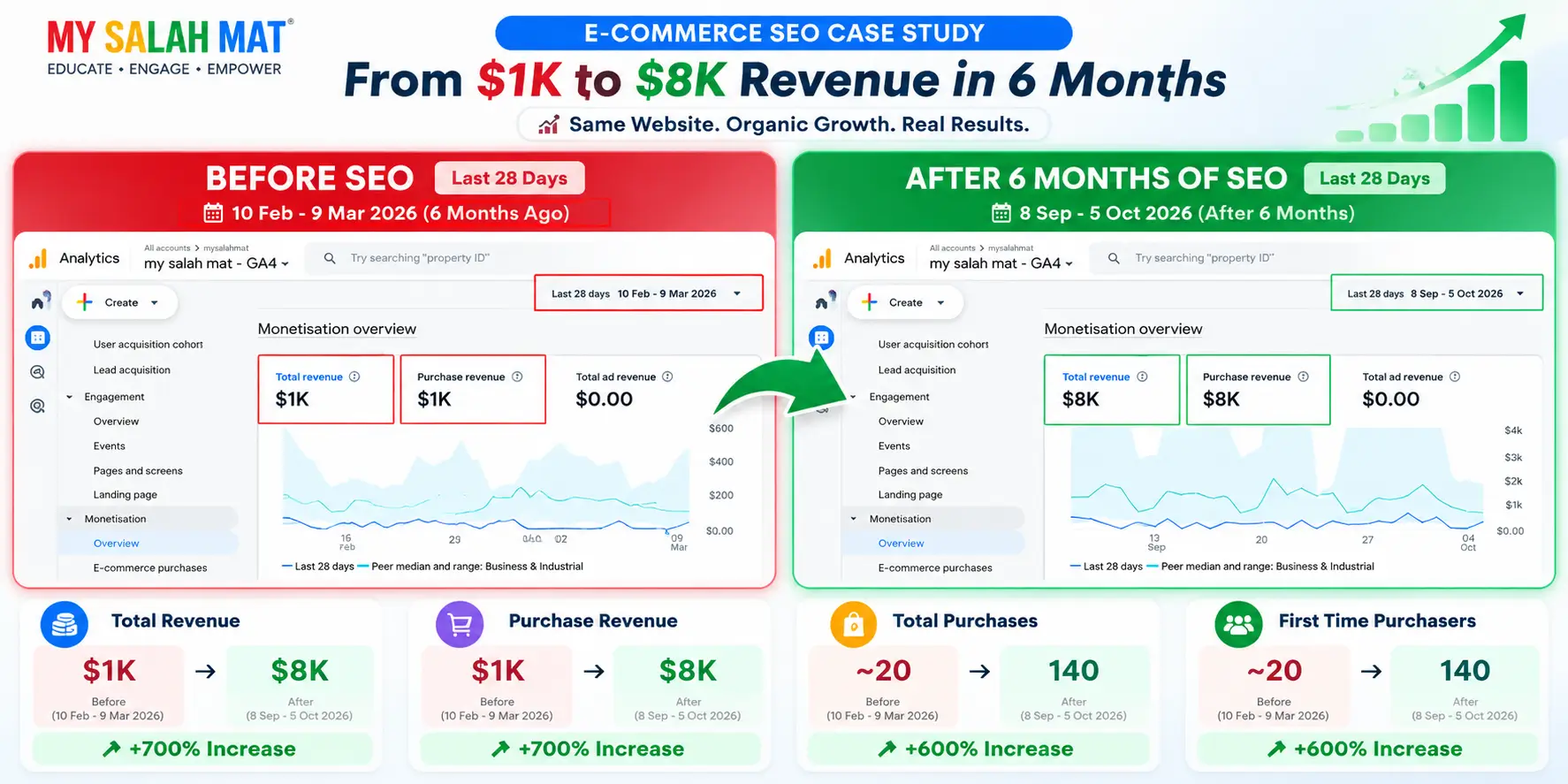
The Google Analytics 4 report for September 8 – October 5, 2026 shows:
- $8K Total Revenue
- $8K Purchase Revenue
- 140 Total Purchases
- 140 First-Time Purchasers
- $0 Paid Ad Revenue
This represents a significant improvement compared with the approximately $1K revenue recorded in the earlier comparison period.
Revenue Growth
Before SEO
$1K
After 6 Months of SEO
$8K
Increase
$1K → $8K
That’s an approximately 700% increase in revenue based on the comparison figures.
The important point is that this is a comparison of ecommerce revenue across the selected periods—not a claim that SEO alone generated every dollar of revenue.
Revenue can be influenced by many factors, including:
- Organic traffic
- Product demand
- Seasonality
- Promotions
- Pricing
- Conversion rate
- Returning customers
- Direct traffic
- Social traffic
- Email marketing
- Brand awareness
For that reason, SEO performance should be analyzed together with GA4 and Google Search Console data.
140 Purchases in the Latest 28 Days
The latest GA4 report shows:
140 Total Purchases
during the 28-day period from September 8 to October 5, 2026.
The report also shows:
140 First-Time Purchasers
This indicates strong new-customer activity within the measured period.
For an ecommerce business, attracting new customers through organic search can create significant opportunities for long-term growth.
SEO Strategy
The growth wasn’t based on simply adding keywords to product pages.
The campaign focused on improving the website as a complete ecommerce ecosystem.
1. Technical SEO
Technical SEO was used to identify potential issues affecting search engine crawling, indexing, and website performance.
The optimization process focused on areas such as:
- Crawlability
- Indexation
- Sitemap
- Robots.txt
- Canonical URLs
- Redirects
- Broken links
- Duplicate content
- Website architecture
- Mobile usability
- Page performance
A technically healthy website provides a stronger foundation for content and ecommerce SEO.
2. Keyword Research
Keyword research was used to identify relevant opportunities across the website.
Rather than targeting only broad keywords, the strategy considered different types of search intent.
Informational Keywords
Users looking for information.
Commercial Keywords
Users comparing products or looking for solutions.
Transactional Keywords
Users who are closer to making a purchase.
Product Keywords
Specific searches related to individual products.
This approach helped create opportunities across different stages of the customer journey.
3. Product Page SEO
Product pages are some of the most valuable pages on an ecommerce website.
Optimization focused on elements such as:
- Product titles
- Meta titles
- Meta descriptions
- H1 headings
- Product descriptions
- Supporting content
- Image optimization
- Alt text
- Internal links
- Search intent
The objective was to make product pages more useful for customers while helping search engines better understand the products.
4. Collection Page Optimization
Collection pages can target broader commercial search terms and help users discover multiple products.
The SEO strategy considered the relationship between:
Homepage → Collection → Product
Relevant collection pages were treated as important landing pages rather than simply product listing pages.
This creates a stronger ecommerce architecture and provides additional opportunities to target commercial search queries.
5. Content Strategy
Content was used to expand the website’s topical relevance.
For an Islamic ecommerce brand, useful content opportunities can include topics related to:
- Islamic education
- Children’s Islamic learning
- Prayer
- Islamic gifts
- Muslim children’s products
- Prayer accessories
- Islamic activities
- Family Islamic education
The purpose of content wasn’t simply to generate more pages.
Each piece of content should have a clear search intent and provide useful information to the target audience.
6. Internal Linking
Internal linking connected relevant content across the website.
For example:
Blog → Collection → Product
An informational article can introduce a topic, then naturally direct the reader toward a relevant collection or product.
This approach helps:
- Users discover relevant products
- Search engines understand page relationships
- Important commercial pages receive internal authority
- Website navigation become more useful
7. Ecommerce SEO
Ecommerce SEO requires optimization beyond individual keywords.
The strategy considered the complete website:
Technical SEO
↓
Keyword Research
↓
Category/Collection SEO
↓
Product SEO
↓
Content Strategy
↓
Internal Linking
↓
Performance Monitoring
This holistic approach helps create a stronger foundation for organic growth.
The Results
After approximately six months of SEO work, the selected GA4 comparison shows a substantial improvement in ecommerce revenue.
$1K → $8K
Total Revenue
$1K → $8K
Purchase Revenue
140
Total Purchases in the Latest 28 Days
140
First-Time Purchasers in the Latest 28 Days
SEO + Ecommerce Performance
One of the most important lessons from this project is that ranking improvements and traffic growth should ultimately support business goals.
For an ecommerce website, SEO success shouldn’t be measured only by:
- Keyword rankings
- Impressions
- Organic traffic
It should also be connected to:
- Product discovery
- Add-to-carts
- Purchases
- Revenue
- New customers
- Conversion opportunities
That’s why I combine SEO performance data with ecommerce analytics whenever possible.
What We Learned
1. Ecommerce SEO Requires a Long-Term Strategy
SEO growth doesn’t happen overnight.
Technical improvements, content development, keyword targeting, internal linking, and authority building can take time to produce meaningful results.
2. Product Pages Matter
Product pages should be optimized for both search engines and real customers.
3. Content Supports Commercial Pages
Informational content can introduce potential customers to a brand and guide them toward relevant products.
4. Internal Linking Is Powerful
Strategic internal linking can connect informational and commercial pages into a stronger website structure.
5. SEO Should Be Connected to Revenue
Traffic is valuable, but ecommerce businesses ultimately need qualified visitors who have the potential to become customers.
Final Result
The My Salah Mat project demonstrates the potential impact of a structured ecommerce SEO strategy over time.
Across the selected comparison periods, the website’s reported ecommerce revenue increased from approximately:
$1K → $8K
while the latest 28-day GA4 report recorded:
140 Purchases
and
140 First-Time Purchasers
The result highlights how combining technical SEO, keyword research, product optimization, content strategy, internal linking, and ecommerce-focused SEO can contribute to stronger online growth.
Looking to Grow Your Ecommerce Website?
I help ecommerce and Shopify businesses improve their organic visibility through data-driven SEO strategies.
My services include:
- Ecommerce SEO
- Shopify SEO
- Technical SEO
- On-Page SEO
- Keyword Research
- Product Page SEO
- Collection Page SEO
- Content Strategy
- Internal Linking
- SEO Audits
If your ecommerce website is getting traffic but not enough customers—or your important product pages aren’t getting enough visibility—an SEO audit can identify the biggest opportunities.
Want to discover what’s holding your ecommerce website back?
Get a Free Ecommerce SEO Audit.